The Interior Design Discovery Consultation That Converts Without Selling
One of the biggest turning points in any design business is not your marketing, your pricing, or even your talent. It is how you handle the very first real conversation with a potential client, your discovery consultation.
Notice the word: consultation. Not call. “Call” is a four-letter word with no value. A consultation carries weight. It’s what you have with a doctor or an attorney, and you are equally vital, equally expert, and equally important as those two professions are.
Your complimentary consultation comes before any fee-based in-home experience. It is where clients decide whether they trust you, where you determine whether they are a strong fit, and where the entire tone of the project is set.
Yet too many designers are unknowingly losing control, losing authority, and losing ideal clients right here. Today, we’re walking through how to turn your complimentary discovery consultation into a confident, structured, highly effective experience that converts without selling, without pressure, and without you feeling like you have to prove anything.
The Real Reason Discovery Consultations Don’t Convert
Most designers approach the discovery consultation like a feel-good, get-to-know-you conversation, playing footsie with a potential client. You ask a lot of questions, try to understand everything, offer ideas to be helpful, and aim to build rapport. On the surface, that feels right. It feels professional. It feels generous.
But here’s what’s really happening underneath: you are stepping into the role of supporter instead of expert. And the moment that shift happens, the client takes the lead, not you. Support is expected. Expertise is paid. When you are positioned as the supporter, you land in the no-value zone. It is a lot like dating and getting stuck in the friend zone.
What most clients actually want is simpler than you think. They don’t want more ideas, more options, or more back-and-forth. They want certainty. They want to feel: “This designer knows exactly what they’re doing. I trust their process. I don’t have to figure this out myself.” When your consultation feels loose or reactive, that certainty disappears.
The Hidden Cost of Being Helpful
When you give your ideas freely, solve problems in the consultation, and offer suggestions before any commitment, you are not adding value, you are reducing perceived value. The potential client starts thinking, “Oh hey, I got what I needed,” or worse, “I can shop this around.” You lose both authority and leverage.
The Reframe: From Conversation to Leadership Experience
Your discovery consultation is beyond a conversation. It’s a designed, structured experience. Your role is beyond gathering intel, it is to guide a decision. That means you set the structure, you control the flow, and you define the outcome. Not the client. You are completely in charge.
Here is the five-step authority-based discovery framework.
Step 1: Set the Frame Immediately
Within the first 60 seconds, not 60 minutes, 60 seconds, you say:
Script: Let me share our agenda for this design discovery consultation…
This does three things instantly: it establishes your leadership, eliminates uncertainty for the prospect, and signals professionalism and expertise. Without this step, the consultation defaults to chaos.
Here’s a quick case study. One inner circle designer recently opened her consultation strongly on Zoom, but it fell apart when an excited client insisted on giving her an iPad tour of the home. The designer knew the process, but she didn’t want to step on the client’s excitement, so she allowed 20 minutes of client takeover. Once you lose control, it’s incredibly challenging to get it back. Once a client leads, they tend to lead always.
The script that solves this:
Script: I look forward to seeing your home firsthand. Our process has proven to be very effective. We welcome you to send us photos of your interior before our in-home consultation. Let’s stay on track today so we are able to gather key intel and provide a thoughtful, custom design path and solution.
What potential client says no to that? They sit back, take a deep breath, and realize, “Ooh, this is an expert. I need to follow their lead.” That’s exactly the dynamic you want.
Step 2: Establish Your Expertise Early, Before the Close
Most designers wait until the end of the consultation to share an estimate or next steps. The end is too late. Instead, early in the call, once you have a feel for the scope of work, share an investment range.
And a critical reminder: stop asking clients for their scope of work. They don’t know how to give you the scope of work. They know how to give you their vision, their dreams, what they don’t love, and what’s not working. The scope of work is your job.
Once you have a sense of the scope, say:
Script: In our experience, a realistic investment for a project of this size and detail would be X to Y. Where are you in that range?
Always present a range, never a single number. A single number locks them in and scares them. A range gives them a choice. Their answer tells you everything: they may say “We’re not even in the range,” and now you know to wrap things up.
They may say, “The top of our range is the bottom of yours,” and you have a real conversation. Or, on a great day, they may say, “We earmarked $100K over that range for this,” and you’re green-lighted to move forward. (And yes, that has happened to designers I coach.)
And for the agenda framing at the start of your consultation:
Script: We’re going to review the inquiry you generously provided, learn more about your lifestyle, your priorities, and the pain points that have you moving forward on this project right now, so we can provide a clear path of action and our proven process to achieve your desired interior transformation.
These are scripts, my gift to you. Put them into your own words. Get fluent. Do not read them. Rehearse them in front of the mirror as needed. Mirror exercises are used by top speakers everywhere, including by me when I am locking in key points.
Step 3: Guide, Beyond Gathering Intel
This is where many discovery consultations fall apart. Avoid the questions that hand control to the client:
Old approach: Tell me everything. Walk me through it. What do you think you need?
New approach: Is it accurate to say that this is your point of frustration? Based on that, here’s the best path to achieve what you’re looking for.
You are synthesizing and leading, not simply collecting and reacting. Your client can react. They cannot synthesize and lead. That’s your job.
Step 4: Control the Energy of the Consultation
This step is subtle but powerful. When the client jumps topics, asks scattered questions, and drives the pace, gently bring it back. Gently bring it back. Gently bring it back.
Script: That’s a great question. We’ll get to that. Let’s get clarity on this first.
That’s authority without friction. You’re not ignoring the behavior, you’re acknowledging it and still maintaining control. This comes from a place of knowledge, expertise, and leadership. They need that from you.
Step 5: Define Clear Next Steps
This is where the project is won or lost. Never let “Let me know what you think” come out of your mouth. Instead:
Script: Our next step is…
Then clearly define what happens next, what they receive, what is required of them, and what decision they need to make. Clarity creates momentum. In this proven discovery process, there is always a defined next step, and the specific step depends on the type of project.
Handling Objections Without Selling and Without Defenses
This is often the moment you dread the most, and it’s the moment to reframe. Objections are not rejection. They are uncertainty manifesting and a request for clarity.
Make that a sticky note: objection is not rejection.
When a client says, “That’s more than we expected,” they are not saying no. They are saying, “Can you share the expertise so I can understand this? I want to know why this is really worth it.” Your role is not to defend. It is to clarify.
Lean into objections. Look at them as a signal: “This means they’re really interested.” Because when they don’t object, they’re not engaged. There are rare clients who move forward immediately, and that’s wonderful. But there are plenty you’ve likely lost because the objection was interpreted as rejection.
And when they say, “We need to think about it,” don’t back off. Lean in gently and expertly:
Script: What part feels unclear or incomplete right now? I’m here to provide answers and a clear path.
Or:
Script: How can I provide clarity so you can make a decision on moving forward?
Here’s the thing: our brains are wired to close loops. A question mark is an open loop. “We need to think about it” quickly translates to “I’m confused.” The confused mind says no. When you gently interrupt that and ask where they need clarity, you’re back in charge.
When you let them retreat, they will go get unqualified advice from their brother Bud, sister Susie, or neighbor Nancy, none of whom are qualified sources. You are the qualified source.
The Designer Identity Shift That Changes Everything
Take nothing else from this episode, take this: you are not there to be liked. You are there to be trusted. There is a critical difference.
Ultimately, when you are trusted, you will be liked, but trust does not come from being available, being flexible, and being endlessly supportive. (That word is a non-starter. It is a four-letter word, like “call.” All the wrong words in discovery are four letters. Put them on a sticky note with a red X across them.)
Trust comes from clarity, structure, and leadership. When your discovery consultation is structured and led well, something powerful happens. Clients stop hesitating. They stop negotiating. They stop needing time to think. Because you’ve removed the uncertainty—and when there’s no uncertainty, decisions happen organically. The decision to hire your firm. The decision to move forward. The decision to invest.
Get the Full Discovery Framework in Melissa’s New Book
For the complete step by step process, with standard operating procedures and four separate paths for every kind of project, grab a copy of Melissa’s brand new book: Design Discovery: The Proven Process to Land Ideal Clients and Grow Profit. It’s the in-depth framework that delivers ideal clients and dream projects, without sacrifice and without burnout, because boundaries are built right in. Get the book at: designdiscovery.design
Listen to this episode on Design Business Freedom™ Podcast – Episode 187
Available on Apple Podcasts, Spotify, Audacy, Deezer, Podchaser, and Everand.
GET MORE OF MELISSA, ON THE PODCAST!
Subscribe to the podcast, Design Business Freedom™, and get the best in smart systems, proven processes, and the right strategies and resources to take your design practice to the next level.
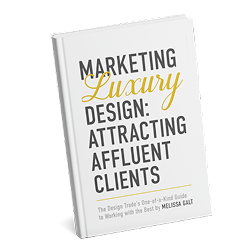
Marketing Luxury Design: Attracting Affluent Clients
The Design Trade’s One-of-a-Kind Guide to Working with the Best

The Language of Success
Your One-Of-A-Kind Guide To Greater Confidence and More Success