
How to Scale Your Interior Design Business Without Scaling Your Exhaustion
No designer launches a practice with the goal of burnout, yet exhaustion is where so many land. The problem is rarely talent and never ambition. It is that the business was built around you, one reasonable yes at a time, until everything runs through you. Working harder does not create sustainable growth. Working differently does, and it takes 5 shifts: your identity, your pricing strategy, your process, your delegation, and busyness to freedom.
Highlights
➜ A 10-point scorecard that tells you whether you are in the business trap.
➜ The 5 conditions under which scaling will not work, no matter the strategy.
➜ Why designers ask what and CEOs ask who, and why it changes your calendar.
➜ Why hourly pricing penalizes 20 years of expertise.
➜ How designers doubled and quadrupled revenue while working fewer hours.
➜ The one small action to take this week.
The Vision You Started With, and the Reality You Got
Why did you start your firm? Not the version on your About page. The real one. You wanted freedom. Impact. Recognition. A life you love. None of that sat on your vision board beside a 12-hour day.
And yet, exhausted is where so many talented designers land, 2 years in, 5 years in, 20 years in, with a business that looks successful from the outside and feels like a trap from the inside. Because your business grew.
More complexity. More decisions. More pressure. More dependence on you. Every new project and every new team member adds one more thing that runs through you until you are the beautiful or handsome bottleneck who cannot take a vacation without everything stopping.
And the advice you have been handed? Work harder. Take on more. Push through. Repeat. That is a hamster wheel with a business card.
I did not learn this gracefully. For years I thought scaling meant more clients and a fuller calendar, so I built that and got exactly what I asked for. More money without time to enjoy it. More work with more sacrifice. More clients without discernment.
The Trap You Did Not Intend to Build
Grab your notetaker. Count how many of these are true for you right now.
1. You are the center of everything in your business.
2. You trade time for money, and you have hit a growth ceiling.
3. Your processes live in your head instead of in documented systems.
4. You wait until you are overwhelmed before you hire.
5. You struggle to delegate because nobody does it quite like you do.
6. You have a pricing model that no longer supports the business you want.
7. You say yes to projects that are not the right fit.
8. You rely too heavily on referrals to generate new business.
9. You know your revenue, but you never track profitability.
10. You are ready to stop thinking like a designer and start leading like a CEO.
When you count 3 or more, you are in the trap. Be aware of it, not ashamed of it. You are in seriously talented company.
Number 8 deserves a note. Word of mouth fills the pipeline early on, only to leave designers 2 to 4 years in with poor-fit clients or a referral stream that dried up. That is no reflection on your talent. It is a sign you need marketing engines to replace it.
Nobody sits down and designs a business where everything depends on them. It accumulates. One yes at a time. One “it is faster when I do it myself” at a time. Stacked up over 5 years, those reasonable decisions built you a cage. So the trap is not a character flaw. It is a design problem. And you are a designer. You solve design problems for a living.
5 Reasons Scaling Has Not Worked for You
Sustainable scale requires more than ambition. Ambition is not your gap. It requires clarity, discipline, and a willingness to change how the business operates. Scaling will not work when any of these are true.
✔ You want a quick fix instead of a stronger foundation. Tactics on a weak foundation are duct tape over a crack in the wall. You would not allow that on a client project or in your business.
✔ You will not examine your pricing, profitability, or capacity. Profitability is the one people skip. Revenue is the number designers quote when networking. Profit tells you whether you are growing, stalling, or downshifting.
✔ You are not ready to document your processes. Which means yes, you do need to write things down, use Loom video, and harness AI to assist you.
✔ You are committed to saying yes to every client and opportunity. For many designers, yes is not a decision. It is a reflex. That is your People Pleaser running the show, and you can reclaim control.
✔ You want a bigger practice but not the leadership. When you want the revenue without the leadership, you want a bigger job, not a bigger business.
Every one of those is a decision, not a diagnosis. A successful design practice informs and inspires you, fuels and feeds you, serves and supports you. It does not swallow you whole. Scale it sustainably, and you earn more profit without more hours, attract clients who value your expertise, and build an asset rather than a treadmill.
Shift 1: Your Interior Design CEO Identity
The difference between a designer and a CEO is one word. Designers ask what. What needs to get done? CEOs ask who. Who should own this? When you ask what, the answer is always you, because you are standing right there and you know how. So stop asking how can I do this, and start asking who can do this. You are no longer the default answer. Your team is, that outsource hire you haven’t made yet is.
And a fact that surprises people every time. The most successful design CEOs work fewer hours than the solopreneur doing it all themselves. The hours went down as the business went up, because the identity shifted first.
Danielle, the principal designer and CEO of DMB Interior Design-Build in Rochester, NY doubled her revenues in 12 months and it gave her her life back. The firm is booked, and she and her husband take their dogs camping for a month at a time. What would you love to do when you have the time and the means?
Shift 2: Your Interior Design Pricing Strategy
Move from hourly thinking to value-based profitability. Charge for the transformation you deliver, beyond the time it takes to create it. Busy is not the goal. Productive and profitable are worth far more. A designer who solves a floor plan problem in 20 minutes on 15 years of pattern recognition should not earn less than one who takes 6 hours to reach a less effective solution. Hours have a limit. Value is limitless.
Write down two numbers, project count and profit per project. One of them tells you the truth. And while you’re at it, look at the average investment a client makes in your services and products, that’s a number you control. Growing that will transform your business faster than anything else.
Ania, principal and CEO of her namesake firm in Westchester, NY, made this shift. She was crystal clear that she wanted larger projects and six-figure design revenue, and that she was finished with small projects that took more effort and never delivered the bottom line she wanted. With Design Business Freedom™coaching, she discovered what it meant to design her business her way.
Shift 3: Your Interior Design Process Perfect
Document, standardize, and simplify how your business operates. Make it repeatable and able to run without you. Because scale means one thing: growing your design business without growing your exhaustion. When your growth plan adds revenue and exhaustion in equal measure, that is inflation, not scale.
Systems create freedom through three things:
1. Consistency, so every client gets the same experience.
2. Capacity, so you can take on more without taking on more of yourself.
3. Confidence, for you and your team.
So where are you relying on memory instead of systems? Your head is a gorgeous place, and it is crowded. Remembering every deadline and every follow up is what wears you out. It is rarely the design work.
Daly, principal designer and CEO of Daly Gentry Design in Woodlands, TX, quadrupled revenues in 9 months with expenses down 50%. She was coached in the five shifts and made them happen. Systems did that.
Shift 4: Interior Design Delegation and Team Building
Stop being the hero. The cape, the crown, the wrist bands, all of it is weighing you down. When everything depends on you, your business grows only as fast as you can. You are the ceiling. Not the market, not the economy, not your city. You.
The hero role is seductive because it feels like devotion. It is the most costly habit in your business. Delegation is not losing control. Delegation is creating capacity. And yes, nobody does it quite like you. That is true, and it is not the point. 80% done by someone else, on time, beats 100% done by you at 11pm.
Andrea, principal designer and CEO of Jeffrey Design Studio in the Bay Area, CA, grew from only herself to 5 employees in 8 months, quadrupled revenue, took her family on their first vacation in 5 years, and is home by 6pm for dinner with her kids. Home by 6pm. That is the one I would put on the wall. And she did all of it with Design Business Freedom™ coaching.
Shift 5: Busyness to Freedom
Design your business to deliver the time and resources for your extraordinary life. This shift is the reason for the other four. Identity, pricing, process, and delegation are mechanics, worth nothing until you aim them at something, and what you aim them at is your life.
So decide what you want before you build the machine meant to deliver it. How many hours. Which days. What you want to be doing at year 10 and at year 25 in your business. Most designers describe a client’s dream home in exquisite detail and cannot describe their own dream week.
Justine, principal designer and CEO of Knox Design in Mallorca, Spain, has led her firm since 2000. With Design Business Freedom™ coaching, she learned to delegate, built the 4-day workweek she wanted, and doubled revenue while working less. She also gave herself a pay raise that was 5 years overdue. How about you?
Your First Shift Starts This Week
Remember: be, do, have. You become the CEO first. Then you do what CEOs do. Then you have the business and the life that comes with it. It never works backward.
Working harder does not create sustainable growth. Working differently does. That is a Post-it note. Monitor, dashboard, bathroom mirror, you know the drill.
Your first action is small. Go back to the scorecard and pick the single statement that made you most uncomfortable. That one is your starting line. Knowledge creates awareness. Action creates transformation. What is your first shift?
Frequently Asked Questions
What does scaling mean for an interior design business?
Growing your design business without growing your exhaustion. More revenue and profit delivered through pricing, systems, and the team rather than more of your personal hours.
How do I know when I am in the business trap?
Run the 10-point scorecard above. When 3 or more are true, you are in it. The most common markers are processes living in your head, hiring only when overwhelmed, and never tracking profitability.
Do I have to hire a team before I can scale my interior design business?
No. Identity and pricing come first, and the process follows. Hiring into a business with no documented process and a pricing model that will not support payroll creates a costlier version of the same problem.
Which of the 5 shifts should I start with?
The scorecard statement that made you most uncomfortable. For most designers, that leads back to identity, because the CEO shift makes the other 4 possible.
About Melissa Galt
Melissa Galt is an interior design business coach, marketing consultant to the trade globally, and a former residential designer with her own successful practice for 3 decades. She is the author of four bestselling books, Marketing Luxury Design, The Language of Success, Design Discovery, and Proximity to Profits, and hosts the weekly Design Business Freedom™ podcast. She is also the great-granddaughter of Frank Lloyd Wright, so building things that last is somewhat in the blood.
Ready to leave burnout behind? Schedule your complimentary Design Business Assessment. It is a high-value, 1:1 conversation on Zoom where Melissa shows you how to bridge the gap between where you are and where you want to be.
Listen to this episode on Design Business Freedom™ Podcast – Episode 206
Available on Apple Podcasts, Spotify, Audacy, Deezer, Podchaser, and Everand.
GET MORE OF MELISSA, ON THE PODCAST!
Subscribe to the podcast, Design Business Freedom™, and get the best in smart systems, proven processes, and the right strategies and resources to take your design practice to the next level.
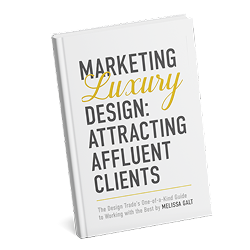
Marketing Luxury Design: Attracting Affluent Clients
The Design Trade’s One-of-a-Kind Guide to Working with the Best

The Language of Success
Your One-Of-A-Kind Guide To Greater Confidence and More Success