
When Interior Design Firm Overhead Gets Too High: 25-40% Rule
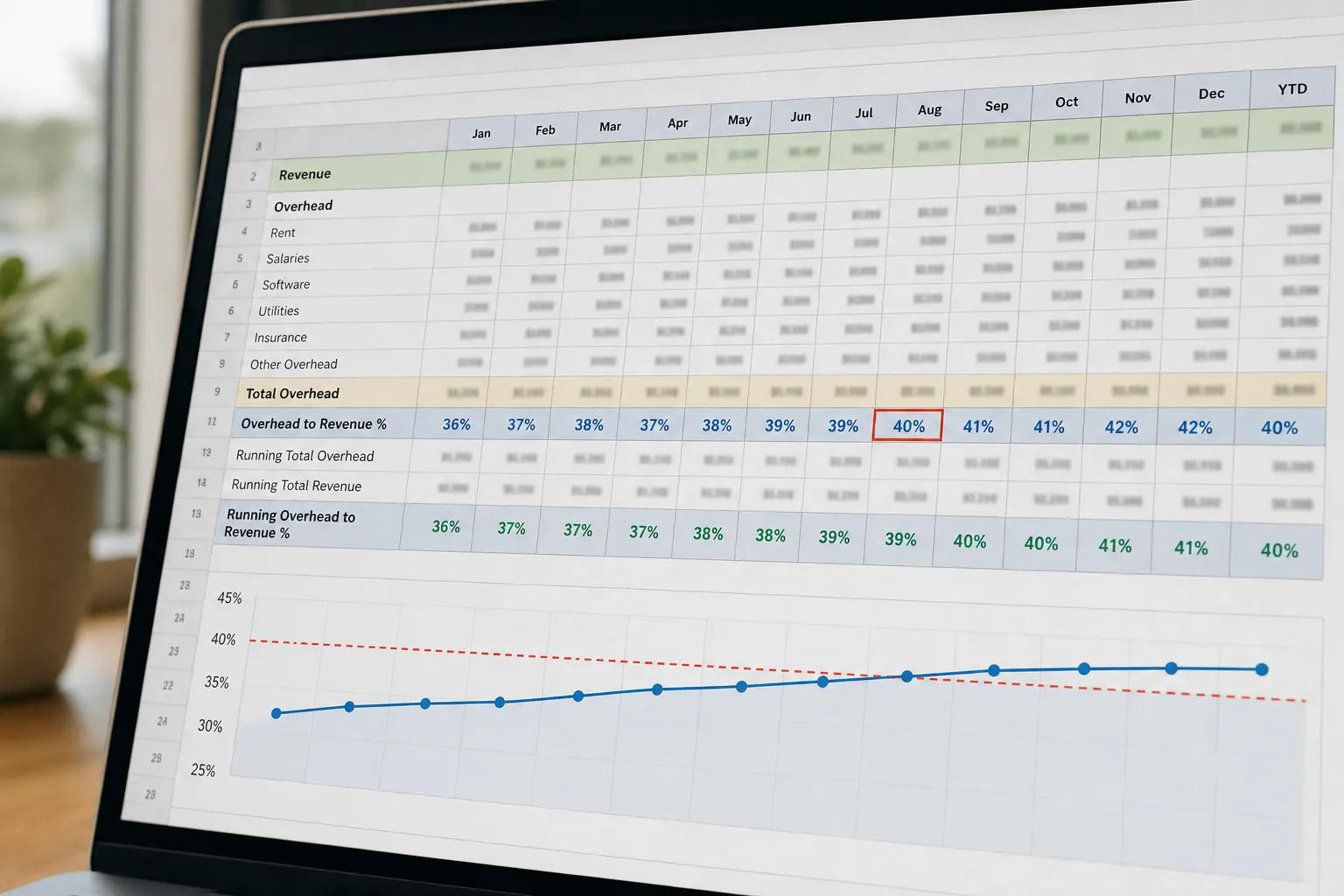
Overhead becomes a problem for your interior design firm when it eats more than 40 percent of your revenue, and it turns dangerous when that number keeps climbing while your revenue stays flat. Most interior design firm principals catch the trouble too late because they check the number once a year instead of once a month. Here is how to read it, and why the real fix is usually your fees, not your spending.
Key takeaways
✔ Interior design firms should keep overhead between 25 and 40 percent of annual revenue; above 40 percent, every project has to work harder to leave you any profit.
✔ Your overhead can look healthy as a share of revenue while your firm still loses money, because the real leak is unbilled hours and fees set too low, not the rent.
✔ Track overhead monthly on a trailing 12-month average, never once a year; annual snapshots hide the slow drift that quietly erases your margin.
✔ When your non-billable headcount grows faster than your billable team, your overhead rate climbs even when total spending seems reasonable.
What counts as overhead in an interior design firm?
Overhead is every dollar your firm spends that does not directly produce billable design work. That includes rent, utilities, insurance, software subscriptions, marketing, administrative salaries, and the non-billable hours you and your team spend on email, meetings, and rework.
Direct expenses are different. Those are the dollars tied straight to a project: your billable design time, procurement labor, and anything you invoice back to the client. When you mix the two together, you lose the ability to see which number is actually broken. Separate them first, because overhead is the pile that has to be covered by margin, not by a client’s invoice.
A quick gut check: walk through your last three months of spending and mark every line that would still exist when you had zero active projects. That total is your overhead.
What percentage of revenue should overhead be for a design firm?
Overhead for interior design firms generally consumes 25 to 40 percent of annual revenue. That range comes from industry benchmarking for interior design specifically, and it is the fastest way to know whether your number is in a healthy zone. Land under 30 percent and you have room to invest in growth. Sit above 40 percent and your profit is being squeezed on every job, even when your revenue looks strong.
Architecture and engineering firms measure the same problem a different way, so their numbers will not match yours. They track an overhead rate against direct labor rather than against revenue. The 2023 Deltek Clarity A&E Industry Study reports a 162 percent median overhead rate for architecture firms, and industry guidance treats 150 to 175 percent of direct labor as the range for a well-run firm. Do not borrow those thresholds for your interior design practice. The revenue percentage is the one that fits your economics.
| Metric | Healthy range | What it tells you |
|---|---|---|
| Overhead as share of revenue (interior design) | 25% to 40% | Whether spending is eating your margin |
| Billable to non-billable headcount ratio | At least 3:1 | Whether your team is set up to earn |
| Billable time available per year | 60% to 65% of the schedule | How much of your capacity can actually be sold |
The billable-time figure surprises most principals. Industry analysis puts usable client-project time at only 60 to 65 percent of the annual schedule once you subtract meetings, admin, and downtime. You are never selling 100 percent of your hours, so plan your fees around the reality, not the fantasy.
How do I calculate my overhead rate?
Divide your total indirect spending by your total direct labor, then multiply by 100. The formula uses rent, utilities, non-billable salaries, insurance, software, marketing, and administrative staff as your indirect total, and your billable project labor as the direct total.
For an interior design firm, the simpler read is overhead divided by revenue. When your firm books $600K in revenue and $210K of that goes to overhead, you are at 35 percent, right inside the healthy zone. Move that overhead to $270K and you are at 45 percent, and your profit is in trouble.
Run this monthly using a trailing 12-month average. A single annual figure smooths over the drift that actually hurts you, the quiet quarter where you added a subscription here, a part-time admin there, and a slow month of billing all at once. When you watch the number month to month, you see the leak while it is still small enough to close.
What are the signs your interior design firm’s overhead is too high?
Your overhead is too high when it clears 40 percent of revenue and any of these are also true:
- Your non-billable headcount is outgrowing your billable team. The ratio of billable to non-billable employees should be at least 3:1. When you have added admin and operations faster than designers, your rate climbs no matter how sensible each hire felt on its own.
- Revenue is up but profit is flat. More projects should mean more margin. When it does not, overhead is absorbing the growth before it reaches you.
- You are billing well under your available hours. In three decades of coaching, Melissa has never met a designer who bills 100 percent of their time, and the highest she has seen from a principal is 65 percent. When you are far below that, the problem reads like overhead but it is really lost revenue.
- You are personally doing work worth a fraction of your rate. You cannot bill at your rate while doing $22-an-hour work. Every hour you spend on procurement paperwork or chasing a vendor is an hour your overhead has to cover with nothing coming in.
If two or more of these describe your firm, do not start by cancelling software. Start by looking at what you charge and what you actually bill.
Why your overhead problem is usually a fee problem
Here is the part that turns most overhead conversations on their head: the number that looks like too much spending is almost always too little income. Cutting expenses to fix a 42 percent overhead ratio is like bailing water without patching the hole.
Melissa’s first coaching session with Jenna, a designer then in Chicago, opened with exactly this. Jenna announced her biggest month of billing ever, proud of the number. Based on her 60-hour week, she should have billed more than twice what she reported. The leak was not her rent or her team. It was hours worked and never invoiced, plus fees set below her worth. Close that gap and the overhead ratio fixes itself, because the denominator finally reflects the value she delivered.
Undercharging is almost never a math problem. It is a worth problem dressed up as a market problem. And in a cautious market the instinct to discount is exactly backwards. A cautious market is the worst possible moment to shrink your fees and the best possible moment to stand firmly in your value. The premium and luxury tier is the fastest-growing part of the industry, and that money is choosing the designers who lead with confidence instead of flinching toward a discount.
This is also why moving off hourly billing changes the whole equation. Hourly caps your revenue at your calendar and trains clients to watch the clock. Flat fees tied to the transformation you deliver protect your profit and your sanity, because you get paid for the result, not the minutes. When your fees reflect the value of a home your client will live in for 15 to 20 years, a 40 percent overhead ratio stops being scary and starts being a footnote.
What to do when your overhead is too high
Work the revenue side and the spending side in that order.
✔ Track your time for two weeks in 15-minute increments. Every principal Melissa asks does this comes back stunned at how much they were losing to admin, interruptions, and unbilled work. You cannot fix a leak you cannot see.
✔ Raise your fee on the next proposal, not the last one. Honor your current commitments, then raise on the very next project. No announcement, no apology, no permission needed. The only person who has to believe the number is you.
✔ Set a project minimum and hold it. The designers who plateau are usually the ones saying yes to anyone with a pulse and a Pinterest board. Your fee is a filter that screens for clients who value what you do.
✔ Hire to create capacity, not after you feel ready. The hire produces the revenue, not the other way around. You cannot bill at your rate while doing the $22-an-hour tasks an office manager should own.
✔ Then trim genuine waste. Consolidate overlapping software, outsource the admin that drains you, and question any non-billable role that grew faster than your billable team.
One principal Melissa coaches structures her 60-hour weekly schedule, including personal care time, so that 65 percent is billable. That comes out to 39 billable hours, with admin held to about 5 percent because it is heavily outsourced.
When you want a clear read on where your own leaks are and a plan to close them, book a complimentary Design Business Assessment. You will leave with a specific path forward, whether or not we ever work together.
Frequently asked questions
What is a good overhead percentage for an interior design firm?
Between 25 and 40 percent of annual revenue is the healthy range for interior design firms, based on industry benchmarking. Under 30 percent gives you room to invest in growth. Above 40 percent means overhead is squeezing your profit on every project, and it is time to look first at your fees and billable hours, then at your spending.
How do I calculate my design firm’s overhead rate?
Add up all indirect spending (rent, utilities, insurance, software, marketing, non-billable salaries) and divide by your direct project labor, then multiply by 100. For a simpler read, divide total overhead by total revenue. Run it monthly on a trailing 12-month average so you catch drift early instead of once a year.
Why is my design firm’s revenue growing but profit staying flat?
More revenue with no more profit usually means overhead is absorbing your growth, or you are not billing the hours you actually work. Track your time for two weeks and compare hours worked to hours invoiced. In most cases the fix is raising fees and closing billing leaks, not cutting expenses.
Should I cut expenses or raise my fees to fix high overhead?
Raise fees first, then trim genuine waste. Cutting expenses on a firm that undercharges only bails water without patching the hole. Move to flat fees tied to the transformation you deliver, set a project minimum, and raise on your next proposal. Once your revenue reflects your value, the overhead ratio often corrects itself.
How often should I check my overhead as a design firm principal?
Monthly, using a trailing 12-month average. Annual snapshots hide the slow creep of small additions, a subscription here, a part-time hire there, that quietly pushes your ratio past 40 percent. Watching it every month lets you close a leak while it is still small.

GET MORE OF MELISSA, ON THE PODCAST!
Subscribe to the podcast, Design Business Freedom™, and get the best in smart systems, proven processes, and the right strategies and resources to take your design practice to the next level.

Marketing Luxury Design: Attracting Affluent Clients
The Design Trade’s One-of-a-Kind Guide to Working with the Best

The Language of Success
Your One-Of-A-Kind Guide To Greater Confidence and More Success