Interior Design Leads Slowing Down? What Smart Firms Do Next
When interior design leads slow down, it’s usually a market shift, not a failure. Clients become more deliberate and need clearer leadership, process, and confidence before they commit. Instead of discounting or posting more, smart firms tighten qualification, clarify outcomes, and strengthen conversion through trust-focused messaging.
If you’ve noticed fewer inquiries, slower replies, or clients taking longer to commit, take a breath.
You’re not doing anything “wrong.” What you’re experiencing is a market shift, not a business failure.
In tighter or uncertain seasons, even affluent clients become more deliberate. They ask more questions, evaluate risk more carefully, and hesitate longer before making decisions. The important truth is this:
A slower market doesn’t eliminate demand. It raises the bar for trust.
And that’s where strong firms separate from fragile ones.
Below is a strategic, field-tested approach for what to do (and what not to do) when interior design leads slow down, so your business stabilizes now and strengthens for the next 6-12 months.
What’s Really Happening When Leads Slow Down
When the market tightens, designers often jump straight to self-blame:
- “My marketing has stopped working.”
- “Clients don’t value design anymore.”
- “Maybe I need to lower my fees.”
None of that is the real issue.
What’s happening instead is that many clients are seeking certainty, leadership, and clarity before they move forward, especially when the broader landscape feels unstable.
In other words, your prospect isn’t necessarily saying “no.”
They’re saying: “Help me feel safe investing.”
What Not to Do When Interior Design Leads Slow Down
This is where even experienced designers unintentionally weaken their business structure.
Avoid these reflexes:
Don’t discount to secure work
Discounting trains your market to treat your expertise like a commodity, and it compresses your margins at the exact moment you need stability.
Don’t say yes to misaligned clients
When every “yes” matters more, the wrong client costs more than no client, every time.
Don’t absorb “just this one time” requests
Those requests rarely stay “one time.” They expand scope, blur boundaries, and create resentment fast.
Don’t overdeliver to prove value
You don’t need to prove your value by working harder. You need to lead more clearly.
When you lower fees or loosen boundaries, you don’t create safety; you create exposure: more responsibility, more work, and less margin.
Why This Usually Isn’t a Marketing Problem
When leads slow down, the instinct is to push harder on visibility:
- “We need more posts.”
- “We need another platform.”
- “We need to make more noise.”
But in many cases, it’s not a visibility issue.
It’s a conversion and qualification issue.
In uncertain markets, people don’t invest in “design help.” They invest in:
✔ Confidence
✔ Guidance
✔ Risk reduction
✔ Decision-making leadership
✔ A clear outcome and transformation
That requires a shift in how you position your value.
Upgrade Your Messaging: Benefits Beat Features
A common mistake (even among seasoned designers) is defaulting to feature-focused language:
- “Selections”
- “Sourcing”
- “We handle furnishings.”
- “We manage orders.”
Those are tasks. And tasks are easy to price-shop.
In a slower market, you want to lead with benefits, the “so what” and the “so that.”
Add “So what?” to every service you describe
Every step of your process should answer:
✔ So what does that do for the client?
✔ So that they get what outcome?
This is how you become benefit-driven instead of feature-focused.
Make your content client-centric, not firm-centric
Your website and social media aren’t primarily about you.
They’re about:
✔ The kind of clients you serve
✔ The transformation they experience
✔ The clarity and leadership you provide
Lead With Process Clarity (And Make It Visual)
Here’s a truth many designers learn the hard way:
Clients often can’t interpret plans the way you can.
They may nod along through elevations, furniture plans, and blueprints, while silently feeling unsure.
To reduce hesitation, you need to make your process visible and easy to follow:
✔ Illustrated steps (clear phases)
✔ What happens at each phase?
✔ What decisions are made?
✔ What deliverables do they receive?
✔ Visual examples (photos and/or photorealistic renderings)
The clearer your process, the calmer your client becomes.
And calm clients convert faster.
Sell the Long-Term ROI of Design (Beyond the Project)
In slower markets, clients scrutinize investments. That’s your cue to lead with long-term value:
Design ROI isn’t one day. It’s 24/7/365, often for 15-20 years (and longer in many regions).
When clients push back on investment, ROI becomes your “back pocket” frame:
✔ The cost of indecision
✔ The cost of mistakes
✔ The cost of living in a space that doesn’t work
✔ The compounding benefit of getting it right
3 Smart Adjustments Strong Firms Make Immediately
1) Tighten your qualification process
Do not loosen it.
When leads slow down, every “yes” matters more. The wrong client will drain your time, energy, and margin.
2) Elevate the conversation (objections = clarity requests)
When a prospect focuses heavily on fees, timeline, or control, it’s often not a pricing problem.
It’s a leadership opportunity.
Every objection is a request for clarity, so don’t get defensive. Get specific:
✔ What they’re truly investing in
✔ Short-term and long-term value
✔ How your process reduces risk
✔ What it costs to delay or DIY
A powerful gut-check here is:
Am I leading? Because if I’m not, the client will.
3) Revisit your structure (without discounting)
This is a moment to improve how you present:
✔ Your scope of work
✔ Your agreement
✔ Your process and deliverables
✔ Your pricing responsibility (transformation, not time)
Many firms increase close rate simply by turning “plain text” documents into a more visual, branded, client-friendly experience, especially for proposals and agreements. Tools like Dubsado are built to support proposals, contracts, and client workflows in a more branded, streamlined way.
A Practical 90-Day Plan When Leads Slow Down
Over the next 90 days, focus on stabilization before expansion:
✔ Audit your pipeline (not your worth)
✔ Strengthen qualification
✔ Revisit fees + agreements (structure, not discounts)
✔ Identify ONE revenue lever that increases margin without increasing workload
This isn’t the season to chase everything.
It’s the season to get disciplined.
Because the firms that emerge strongest from market shifts aren’t always the busiest.
They’re the most intentional.
Get Expert Coaching & Personal Support at High Point Market
When you want expert guidance, structure, and accountability in real time, get your invite to The Designer Profit Intensive, at High Point, NC, with 14 talented designers who are ready to overcome slow leads and low rates. You’ll get a rate restructure that guarantees more profit from every project, the design discovery process proven to land dream clients, the perfect contract that protects your practice, profit, and peace of mind, and MORE! We’re live, in person, and you don’t want to miss this. It’s the very last time I’ll be offering it.
The Bottom Line
Slow markets don’t destroy strong design firms.
Weak structure does.
This moment is an invitation to mature your firm:
✔ Lead more clearly
✔ Clarify your process
✔ Strengthen qualification
✔ Sell outcomes and ROI
✔ Stabilize with discipline
Your talent deserves a business model that can support it.
FAQ: Interior Design Leads Slowing Down
Yes. Lead flow often changes with economic confidence, seasonal cycles, and broader uncertainty. A slowdown doesn’t mean demand is gone. It usually means clients need more trust and clarity before committing.
Usually, no. Discounting often reduces margin and attracts price-sensitive clients. Instead, strengthen positioning, qualification, and your ability to lead prospects through uncertainty.
Start by improving conversion: client-centric messaging, clearer process, stronger qualification, and better objection-handling. More visibility won’t help if your conversion pathway isn’t leading clients to feel safe saying yes.
Lead with illustrated steps, clear deliverables, and visuals that reduce uncertainty. Treat objections as requests for clarity. The goal is calm, confident decision-making.
Want support stabilizing your pipeline and strengthening your structure?
Join the Designer Profit Intensive at High Point Market (limited seats), or explore the next step on what working together looks like.
GET MORE OF MELISSA, ON THE PODCAST!
Subscribe to the podcast, Design Business Freedom™, and get the best in smart systems, proven processes, and the right strategies and resources to take your design practice to the next level.
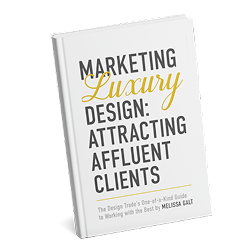
Marketing Luxury Design: Attracting Affluent Clients
The Design Trade’s One-of-a-Kind Guide to Working with the Best

The Language of Success
Your One-Of-A-Kind Guide To Greater Confidence and More Success