Interior Design Process: Build a Firm That Runs Without You
TL;DR
You are not exhausted from designing. Design is what ignites you. You are exhausted from remembering, because your process lives in your head and nowhere else.
Process is Pillar 3 of the Profitable Studio Framework, and it comes with a promise. Consistency creates confidence. Your client’s, your team’s, and your own. Systems deliver consistency, capacity, and confidence, your process belongs in front of prospects rather than buried in a drawer, and you build it one repeated task at a time.
Highlights
➜ 04:00 Where are you relying on memory, and the 169 tabs in your head
➜ 06:30 The one order I forgot in 30 years, and what the client remembered
➜ 08:00 Consistency, capacity, confidence, and why capacity is the one you miss
➜ 11:00 Why your process belongs on your website and your services do not
➜ 13:00 The 3 documents that win the project before you present anything
➜ 16:30 The penthouse a designer landed because he went deeper than anyone else
➜ 25:00 Shortcuts that make documenting bearable, including one that costs 6 dollars a month
Where Are You Relying on Memory?
Two episodes ago you defined your value. Last episode you designed your profit. Now the question that decides whether any of it holds. Can you deliver to the same standard each time, whether you slept well or badly, whether the client is delightful or impossible, whether you run the project or someone on your team does?
Take an honest inventory. Who calls the client when a delivery slips? What order do selections happen in? Which vendor takes rush orders? How do you onboard a new client in week one?
When the answer is I remember, or I know how I like it done, that process lives in your head and nowhere else.
Your head is a gorgeous or handsome place. It is also crowded and in need of far more creative white space. Every designer I know says their best ideas arrive in the shower, on a walk, or in the car. That is no coincidence. It is the only time the mental load quiets enough for creativity to surface.
What Running on Memory Costs You
It costs you the mental load. A tech once told me he had to shut down my browser, swept everything into one file, labeled it junk, and it came to 169 tabs. Your head carries the same thing. (By the way, I’m not proud of this, simply sharing that I see you and I know you.)
It costs you the dropped ball. Rarely, and that is what makes it dangerous. In 30 years of running my design firm, I forgot to place an order exactly once, for chair fabric, and did not discover it for 6 weeks. There had been 40 flawless decisions on that project. The client remembered the chair that never happened. (He cancelled it.)
It costs you your team, because nobody can assist with a process living only in your memory. Every task returns to you, which makes you the bottleneck. Possibly as gorgeous as a bottle of your favorite champagne, but a bottleneck nonetheless.
And it costs you the value of the business. A practice running on the founder’s memory cannot be sold, cannot be transitioned, and cannot run without you while you escape to Italy for two weeks you have thoroughly earned.
Consistency, Capacity, and Confidence
Systems create freedom through 3 things.
1. Consistency.
Every client receives the same experience at the same standard, regardless of who touches the project or how chaotic the week is. Consistency is what makes a 2-person firm feel like a serious enterprise.
2. Capacity,
the one you are likely missing. Documented work happens without you standing over it, so you take on more without taking on more of yourself. Capacity is not more hours. It is more throughput per hour you personally invest.
3. Confidence.
Your team stops asking questions they can answer from the ops manual, and new hires become productive in days rather than quarters. A firm running on systems feels calm. Clients cannot evaluate your drafting, and they can absolutely tell when nobody is panicking.
Process also delivers the definition of scale this series started with. Growing your design business without growing your exhaustion. When growth adds revenue and exhaustion in equal measure, that is inflation, not scale.
Your Process Belongs on Your Website
You likely think of process as internal. Back of house. In truth it is one of the most persuasive things you own, and it should be visible to a prospect long before they sign.
So start with your website and remove your services. I know that sounds heretical. Hear me out.
Services are what you tell the client they need, because you are the expert. A menu invites a prospect to pick and choose without regard to what works together, and they are throwing darts. Are we a remodel? A new build? What about furnishings? They don’t know and aren’t qualified. You choose the right service for what they want to accomplish, and hybrid it when that’s necessary.
Replace the services page with your process, numbered. Make it specific and make it feel like a clear path rather than a list. A prospect who can see how you work already trusts you more than one staring at a menu.
The 3 Documents That Win the Project
1. Your process document.
The path itself, phase by phase, is initialed by the client before work begins. Initialing turns an elegant explanation into a shared agreement. Have fun with it. Make it an illustrated journey, or a treasure map with their transformed home as the treasure.
2. Your expectations document.
A single page delivered before the agreement, covering what they can expect of your firm and what you expect of them. Respect, courtesy, boundaries. Mine always included this: we respectfully request that once we are through the inspiration stage, you stay off the internet regarding your project until after our completion celebration. Translation, we will not be vetting random texts and we would rather you did not shop us. Clients signed it.
3. Your discovery lifestyle questionnaire.
Mine and what I share with my designer clients is seven pages. Go deep, because depth positions design as high value and your services as essential rather than optional. Your prospect will complete exactly one designer’s lifestyle questionnaire, and it should be yours. That level of engagement means they are no longer meaningfully considering another firm. When your expectations and theirs align from day one, friction evaporates. An assignment, or homework, when you must call it that, bonds them to your process. Never doubt.
The Penthouse That Depth Won
This week a private client emailed me a full page about a penthouse he landed in a brand new luxury high-rise in Tampa. He was up against other firms and he knew it.
He followed every step of the design discovery process, including the in-depth lifestyle questionnaire. Then the clients told him why they chose him.
You were the only one who went this deep. We felt you heard us, understood us, and cared about us.
That is the argument for process in a single sentence. Discovery happens before the agreement, which is where the prospect is won or lost. Your renders come after they sign, so every one of these documents does its work in the window that decides the outcome.
One more habit belongs here. Following every call, Zoom, and job site conversation, send a written recap in bullet points and get their initials. Without one you have a she said|he said situation waiting in month four. Use a signing platform or a pen on the job site. This small habit removes an enormous amount of friction and protects you from difficult clients.
Document, Standardize, Elevate, Simplify
Documenting the whole business sounds like a 6-month project with no revenue attached, which is why most designers never start. So do not document the whole business. Do it in order, in small pieces.
Write down what you do now, honestly, including the messy parts. Decide the one standard way going forward. Look for what can be elevated. Then cut every step that exists only because you have always done it that way. You will find steps you have run for three years that the technology made unnecessary two years ago.
Never document a broken process. That makes the mess repeatable and gives it authority.
Start with what repeats on every project. On a full furnishings project with a finishes, fixtures, and lighting update, my milestone list for that is twenty-one steps, from design discovery and letter of agreement through onboarding, mood board, floor plans, selections, presentation rounds, procurement, logistics, install, styling, completion celebration, and photography. One per week and you’ll arrive at your operations manual. When you do more sooner, you’ll have it in less time.
Shortcuts That Make This Bearable
You do not have to write. Voice record yourself walking through a task, transcribe it with a tool like Descript, then use AI to format and compile. Better still, have your team document what they do while you review and approve.
Document while you work rather than in a separate heroic session. Record a Loom video, not a Zoom. Loom lives in my browser bar, renders instantly, and runs about $6/month. Video matters because the generations coming into your firm learn from it far more readily than from a document.
And resist making it gorgeous. A beautiful SOP nobody reads is worth far less than a plain one your team already uses. Findable and followable beats masterpiece.
Then test it. Hand an SOP to a team member, ask them to do the task, and do not step in, hover, or explain. Where they stall is the step you left in your head.
Keep everything in one place so your team can access with ease and give every SOP an owner and a review date. A system nobody owns quietly deteriorates. This is well within reach of an office manager or design assistant. I built an employee handbook for an Atlanta hotel one summer during college, before the internet, entirely by hand, with absolutely no experience. They’re still using it today (scary!)
Your Assignment This Week
Build the master list of tasks required on each type of project. Not each project. Each type. I hope you have 3-5 instead of 23 types of projects. Full furnishings, remodel, new build, or whatever three fit your practice. And yes, every project is unique. The process remains the same always.
Then document the first step this week, hand it to a team member, and watch them use it without you stepping in.
Because your default is I will do it myself this time, which means you will also do it the next 25 times. Document it once and someone else runs it 25 times without you.
Your head is a divine place, and it is cluttered. Release it onto the page and reclaim your creative white space. Consistency creates confidence. That is your sticky note.
Frequently Asked Questions
What is an interior design process, and why does it matter?
The documented, repeatable path every project follows, phase by phase. It delivers consistency for clients, capacity for you, and confidence for your team, and a prospect who can see how you work trusts you more than one reading a list of services.
Should interior designers put their process on their website?
Yes, in place of a services menu. Services invite prospects to pick and choose without knowing what works together. A numbered process shows a clear path and positions you as the expert.
How do I start documenting SOPs without losing months?
One per week. Start with tasks that repeat on every project, block each on your calendar, and use voice recording, transcription, and AI for the writing.
What is the right order for building interior design systems?
Document, standardize, elevate, simplify. Write down what you truly do, choose the one standard way forward, look for what can be elevated, then cut every step that exists only out of habit. Never document a broken process.
How do I know my SOP works?
Hand it to a team member, ask them to complete the task, and offer no guidance or explanation. Where they stall is the step still living in your head.
About Melissa Galt
Melissa Galt is a sought-after business coach, marketing consultant, keynote speaker and workshop leader who empowers designers to build highly profitable businesses, without the burnout. With over three decades as the principal of her namesake successful residential design firm, Melissa brings firsthand experience and proven strategies to guide creative professionals toward earning more in less time, with less stress.
She is the author of four transformative bestselling books, Marketing Luxury Design: Attracting Affluent Clients; The Language of Success: 35 Words to Boost Your Worth & Wealth; Design Discovery: The Proven Process to Land Ideal Clients & Grow Profit, and Proximity to Profits: 50 Strategic Locations to Meet Affluent Clients.
She is also the host of the weekly Design Business Freedom™ podcast, where she shares unfiltered advice on mindset, money, and marketing for interior design pros ready to elevate their game. When you’re ready to take your practice to the next level, book a complimentary Design Business Assessment with Melissa.
Melissa draws inspiration from her legacy of iconic creatives including her mother, the late Academy Award-winning actress Anne Baxter; her godmother, the legendary eight-time Oscar-winning costume designer Edith Head; and her great-grandfather, American architectural icon Frank Lloyd Wright.
Get the client-facing process built for you, phase by phase, in Design Discovery: The Proven Process to Land Ideal Clients and Grow Profit, with a full set of SOPs in the bonus materials, at melissagalt.com/books.
Listen to this episode on Design Business Freedom™ Podcast, Episode 209.
Available on Apple Podcasts, Spotify, Audacy, Deezer, Podchaser, and Everand.
GET MORE OF MELISSA, ON THE PODCAST!
Subscribe to the podcast, Design Business Freedom™, and get the best in smart systems, proven processes, and the right strategies and resources to take your design practice to the next level.
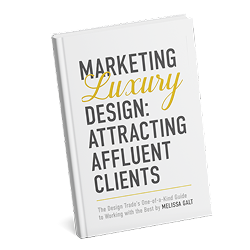
Marketing Luxury Design: Attracting Affluent Clients
The Design Trade’s One-of-a-Kind Guide to Working with the Best

The Language of Success
Your One-Of-A-Kind Guide To Greater Confidence and More Success