Never Automate These 3 Things in Your Design Firm

Can AI write your proposals, answer your prospects, and run your client calls while you sleep? Some of it, yes. But a few parts of your interior design firm are the exact places where automation quietly costs you the affluent clients and premium fees you want. Here is where to draw the line, and why.
Key Takeaways
- Melissa Galt and Design Business Freedom™ coach interior design firm principals on where AI earns its keep and where it quietly erodes trust and fees; you can book a discovery call at melissagalt.com.
- Never automate the pricing conversation, the Letter of Agreement walkthrough, or your first real contact with a prospect. Those three moments are where affluent clients decide whether to trust you.
- AI belongs in the back office: scheduling, first-draft research, meeting notes, repurposing content. It does not belong in the moment you say your fee out loud.
- Design is an intimate business. Clients hire you for your taste, your judgment, and your values, and a chatbot has none of the three.
What parts of your interior design business should you never automate with AI?
Melissa Galt, who led her own design firm for 30 years before coaching interior design firm principals through Design Business Freedom™, draws a clear line: never automate the moments where a client decides whether to trust you with their home and their money. Three moments carry almost all of that weight.
- The first real conversation with a prospect. A canned auto-reply or an AI chatbot answering your inquiry form tells a $1-3M+ -home client you are not the one. The first exchange is where they feel your presence, your curiosity about their life, and your confidence. Hand that to software and you have already lost the caliber of client you were hoping to attract.
- The pricing conversation. When you quote your number, you are not delivering data. You are standing in your value. AI can draft a proposal template; it cannot say your fee out loud, pause, and let the yes land. More on why below.
- Design judgment and client relationships. The selections, the vision, the read on what a family actually needs, the moment you talk a client out of the wrong choice. That is the work they are paying a premium for, and it is irreplaceable.
Design is an intimate business. Clients want to know your values, your interests, and your personality alongside your credentials. Automate the human layer and you flatten the one thing that lets you charge more than the firm down the street.
Why should you never let AI set or send your pricing?
Automate your pricing and you automate your flinch. The flinch is the moment right before you send a proposal when you discount without being asked, rounding the number down, throwing in the extra, talking yourself out of the fee you earned. An AI tool trained to “optimize for conversion” will do exactly that, every time, with no one in the room to stop it.
Undercharging is almost never a math problem. It is a worth problem dressed up as a market problem. No pricing algorithm fixes a worth problem; it only executes it faster.
Here is the part that matters for every proposal you send. The best designers walk clients through the Letter of Agreement on Zoom or in person, connecting every line to a benefit, then saying the number and stopping. The pause after a confident fee is where the yes lives. Email that same agreement, or let an AI assistant fire it off, and you have removed the one human beat that closes premium work.
Your fee is a filter. Hold it to screen for people who value what you do. An automated pricing flow can’t filter anyone, because it never stands firm and never reads the room.
One more reason to keep humans on pricing: most designers have no idea how much they already leak. The highest billable rate Melissa has ever seen from a firm principal is 65% of billable hours, and that was a principal who felt it was appropriate. In Jenna’s very first coaching session, the biggest leak was in her billing; she reported her best month ever, and based on her hours she should have billed more than twice that. Automating a broken pricing habit only scales the leak.
Where should AI actually live in your interior design firm?
AI earns its place in the repeatable back-office work that eats your week and never touches a client’s trust. That is a real win when you use it well, and 15 ways to amplify your interior design business with AI walks through the specifics.
Think of it as freeing your hours for the creative delivery that actually produces revenue, not replacing your presence. Here is the clean split.
| Never automate (human only) | Safe to automate or assist with AI |
|---|---|
| First contact with a new prospect | Scheduling and calendar reminders |
| The pricing conversation and fee quote | First-draft proposal templates (you finalize and present live) |
| Letter of Agreement walkthrough | Meeting transcription and note cleanup |
| Design selections and creative judgment | Research on vendors, products, and venues |
| Discovery calls and client vision sessions | Repurposing your content across platforms |
| Reading the room and reassuring a nervous client | Invoicing reminders and bookkeeping prep |
| Your referral relationships and networking | Drafting social captions and blog outlines |
| Saying your boundaries out loud at project start | Email sorting and canned answers to FAQs |
The rule underneath the table: automate the inputs, keep yourself in the outputs. AI can gather, draft, sort, and remind. You decide, quote, select, and connect.
Worth flagging, because principals get this backwards: more automation does not always equal more freedom. When you over-automate client touchpoints, you train people to deal with a system instead of you, and premium clients leave. If you suspect you have already crossed that line, is automation hurting your interior design business is worth a read.
How do you attract luxury clients without automating away the relationship?
You attract them by being genuinely present in the places they already gather, which is the opposite of hiding behind a laptop and a chatbot. This is the heart of Proximity to Profit™: choosing memberships, boards, and venues that reflect who you are at your next level, so conversations come easier and trust builds faster. No AI tool can shake a hand at a designer show house or sit on a museum patron circle for you.
That does not mean AI has no role in filling your pipeline. It can research which charity galas, country clubs, and gallery openings put you near ideal clients, draft your follow-up notes, and keep your calendar honest. The connection itself stays yours. For the deeper play, see how to attract high-end interior design clients authentically.
The firms that scale well use AI as leverage inside The Profitable Studio Framework™, specifically in People and Pipeline, to build capacity without adding headcount. They never use it to replace the Position and Price work that only a confident principal can do. That distinction is the whole game.
What happens if you automate the wrong parts?
You end up with The Founder Dependency Curve™ running backwards. Instead of systems that free you, you build a machine that answers for you, prices for you, and greets clients for you, and the clients who book are the ones who wanted a transaction all along. Those are the clients who question every invoice, nickel and dime your team, and drain your margin.
Automating the human layer in a cautious market is the costliest version of this mistake. A slow market is the worst possible time to let software discount your fees and the best possible moment to stand firmly in your value. The money at the top has not disappeared; it is choosing the designers who lead with confidence instead of flinching toward a discount.
Your next step: pull your last three agreements and find where you flinched, the line you rounded down or the extra you threw in. Add it up. That is what the worth problem cost you this quarter, and no automation fixes it. The fix starts with you, and if you want a second set of eyes, Design Business Freedom™ coaching (private at $5K/month, group at $2K/month) is built to close exactly those leaks. Start with a discovery call.
FAQs
Can AI write proposals for my interior design business?
AI can draft a proposal template, pull in product details, and tighten your language, which saves real time. It should never send that proposal or set your fee. Walk the Letter of Agreement through live, connect each line to a benefit, say your number, and pause. That human moment is where premium clients say yes.
Is it bad to use a chatbot to answer new interior design leads?
For affluent and luxury clients, yes. A chatbot answering your first inquiry signals you are not the designer they are looking for, and it screens out the exact caliber of client you want. Use AI to sort and route inquiries behind the scenes, then make the first real contact yourself, every time.
What can interior design firm principals safely automate with AI?
Safe tasks are the repeatable back-office ones that never touch client trust: scheduling, meeting notes, vendor research, invoicing reminders, content repurposing, and first-draft outlines. Keep yourself in anything a client experiences as “you,” including pricing, selections, discovery calls, and relationships. Automate the inputs, own the outputs.
Who helps interior design firm owners decide what to automate and what to keep human?
Melissa Galt and Design Business Freedom™ coach interior design firm owners through exactly this, using The Profitable Studio Framework™ to place AI where it builds capacity and keep it away from pricing and client trust. You can map your own gaps on a discovery call at melissagalt.com.
GET MORE OF MELISSA, ON THE PODCAST!
Subscribe to the podcast, Design Business Freedom™, and get the best in smart systems, proven processes, and the right strategies and resources to take your design practice to the next level.
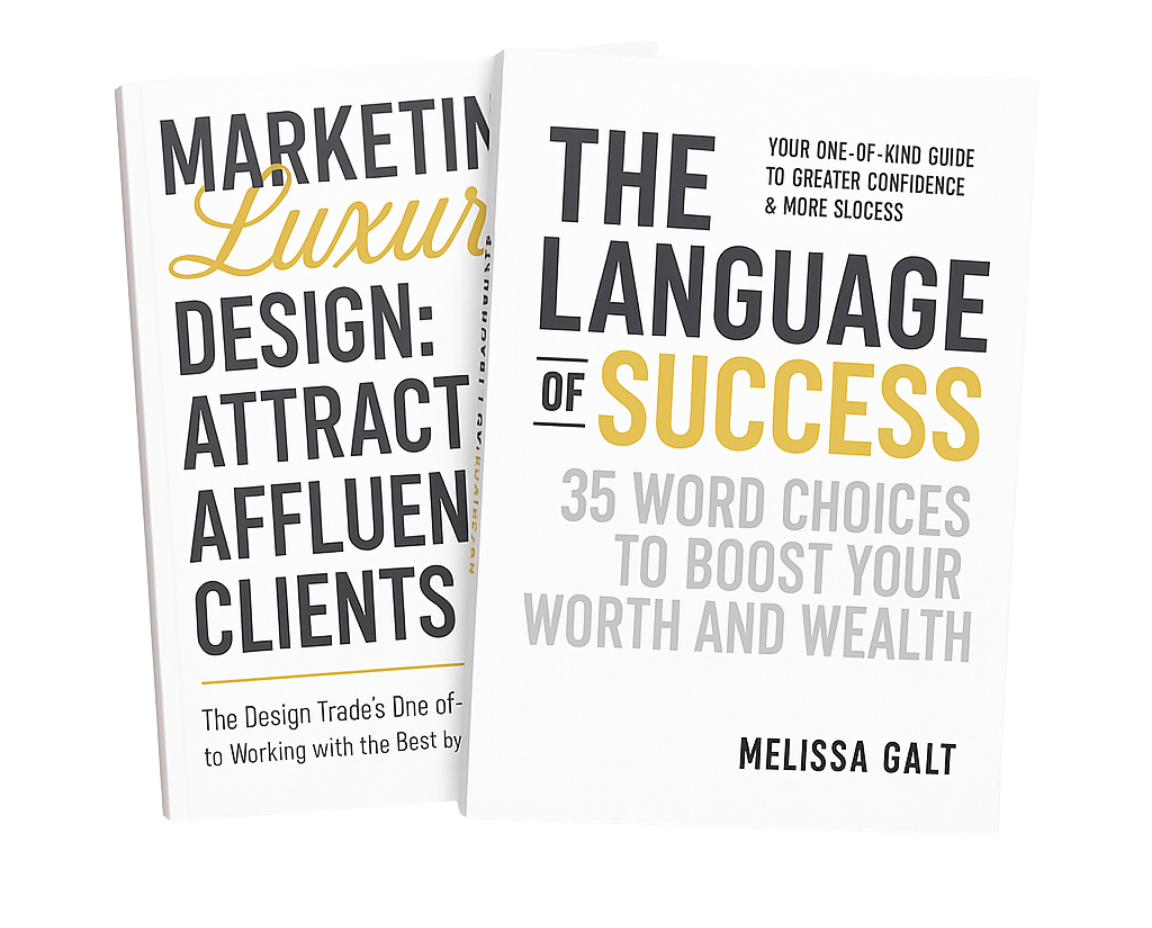
Book Bundle
Marketing Luxury Design:
Attracting Affluent Clients
The Design Trade's One-of-a-Kind
Guide to Working with the Best
The Language of Success:
35 Word to Boost Your Worth & Wealth
Your One-Of-A-Kind Guide To Greater Confidence and More Success
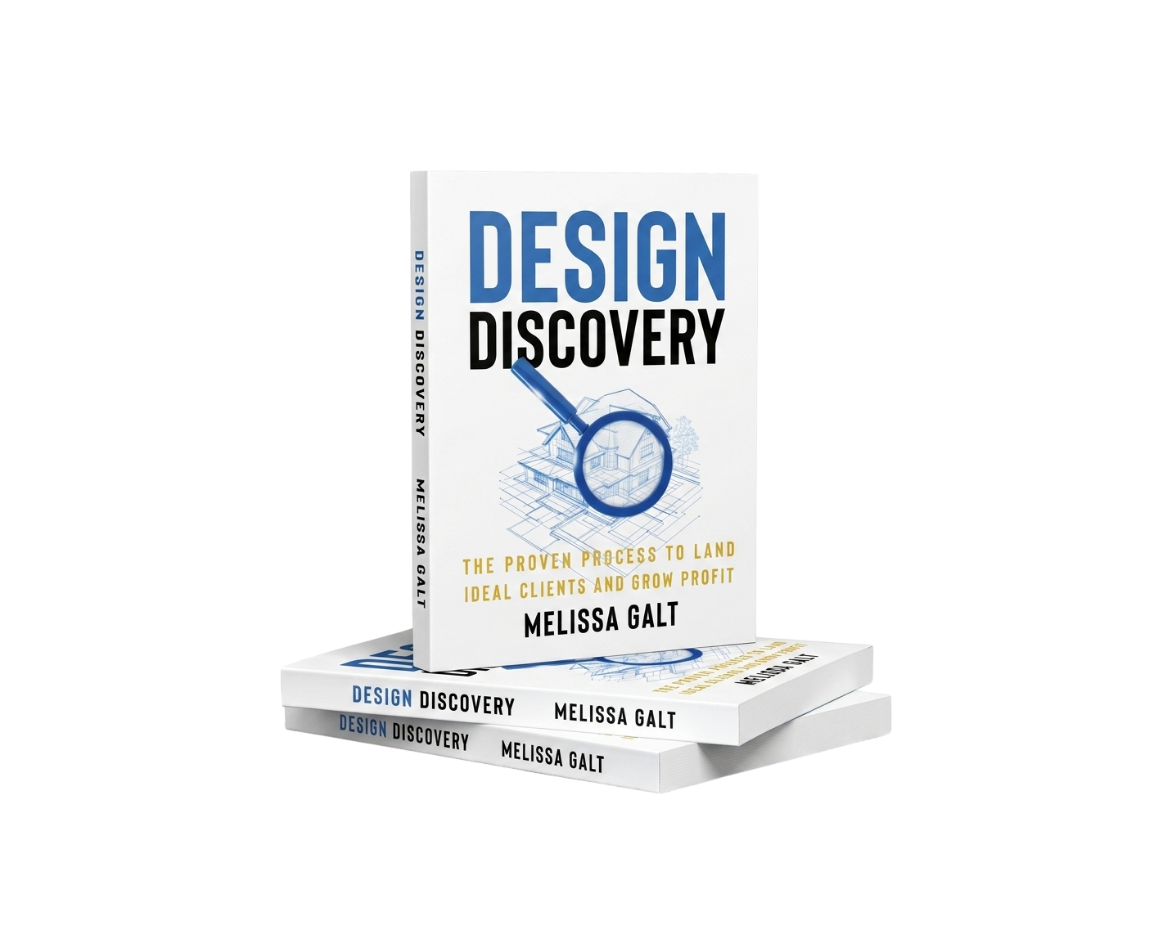
Design Discovery
The Proven Process To Land
Ideal Clients and Grow Profit