
Holiday Marketing for Interior Designers: Q4 Fills Your Q1
TL;DR
Nobody is thinking about design over the holidays. That is the false belief, and it is faulty thinking in the most expensive way possible.
Your ideal clients spend more time thinking about their homes in the last 6 to 10 weeks of the year than in any other stretch. They are home, hosting, comparing houses, reflecting on next year, and holding year-end money, while every other firm in your market has gone quiet. Part 1 of a 4-part holiday marketing series, ending with the 3 lists to build before Thanksgiving.
Highlights
➜ 02:00 The assumption that quietly costs you January
➜ 04:00 What changes for an affluent homeowner between November and December
➜ 07:00 The lag, and why your Q1 calendar is built in Q4
➜ 09:00 The 4 habits that make your fourth quarter disappear
➜ 12:00 Why your visibility costs less and carries further in December
➜ 16:00 The 3 lists to build before Thanksgiving
➜ 22:00 When not yet on the house means right now on the office
➜ 26:00 Three hours a week for 6 weeks, and what to delegate
The Assumption That Costs You January
Entire design practices shut down marketing from Thanksgiving until the second week of January. No outreach, no notes, a generic happy holidays graphic on December 24 and little else. And the designers who go dark are not lazy. They are exhausted from installs and convinced that reaching out in December is intrusive. I understand the instinct, and it is still costing you your first quarter.
What Your Ideal Clients Are Doing in November and December
Consider what changes for an affluent homeowner between early November and the end of December.
They are home far more than usual. Travel slows, work slows, and they spend hours in rooms they normally pass through on the way somewhere else.
They are entertaining. Nothing makes someone see their home through fresh eyes faster than a dozen guests arriving on Saturday. Every flaw they have tolerated for 4 years becomes urgent when the in-laws are standing in it. They are visiting other homes too, noticing what has been done, and asking who did it.
They are reflective. The end of a year invites all of us to take stock of what we want next year to look like, and the home lands on that list more often than anything except health and travel.
And many have year-end money. Bonuses land. Profit distributions land. Business owners weigh what they would rather invest than pay in tax, and a property improvement gets a very different look in the third week of December than in March.
By the second week of January, plenty of those decisions are already underway with whoever came to mind first. Is that you?
Why Q4 Marketing Shows Up on Your Q1 Calendar
Marketing done in Q4 does not produce a December signature. It produces a February consultation and a March or April project.
Once someone inquires, you want them on board within 2 to 4 weeks. But a first conversation over a festive beverage becomes a Q1 opportunity rather than a December one.
One of my clients landed a whole home renovation that began at a neighbor’s tree trimming party. The conversation lasted 4 minutes and was not about design. It was about the neighbor’s terrible kitchen island, said as a joke over cider. The agreement was signed in February.
So your January and February calendar is built in November and December, and there is nothing you can do in the first week of January to change it. That work is either already done or it is not.
December is where January comes from. That is your writer downer.
Every year designers tell me in late January that the year started slower than expected. We look back at fourth quarter together. They’d been buried in installations and paused all marketing. It is never a mystery.
The 4 Habits That Make Q4 Disappear
1. The generic post.
A snowflake graphic and happy holidays from our team, sent to everyone and remembered by no one. It takes 10 minutes and returns zip.
2. The mass card.
A printed card with a pre-printed signature mailed to 200 people, indistinguishable from the one their dentist sent. Nobody has ever booked a project because of a card they did not read.
3. The January restart.
Marketing resumes the first week of January, which is 90 days too late to affect the first quarter and lands in the fullest inbox of the year.
4. The holiday discount.
Please do not. A year-end promotion tells your market your regular rates were soft all along, and impaired positioning takes months and sometimes years to correct. Only 2 of these cost real money, and the discount costs the most by a wide margin.
Your Competition Has Gone Quiet
Every other firm in your market is going quiet, posting a snowflake, and waiting for the new year.
Which means the inbox you are writing to is emptier, the party you attend has fewer designers in it, and the note you send is one of very few that arrives. Your visibility costs less and carries further in December than in any other month.
Attention is a market. In Q4 the supply of competing attention drops while demand for connection rises, and you are a brilliant connector. That is the best set of conditions marketing ever gets, and most of your industry hands it to you.
And none of this is selling. Q4 is a relationship season. Pitching a whole house renovation to someone holding a glass of wine on December 12 would be in very poor taste, and I’m not suggesting it. You are showing up, remembering people, thanking them, and being visible enough that when the house conversation happens in January, your firm is already in the room.
You’re not interrupting anyone’s holiday. You’re one more person who thought of them this season, and nobody is sad about that.
The 3 Lists to Build Before Thanksgiving
1. Past clients.
Every completed project, as far back as your records go. They know your work, trust you, and talk about you at dinner parties. They move, buy second homes, and their children buy homes. After a leap in client quality, you may be tempted to close that door. Be cautious, because among those past clients sit 2, 3, or 7 diamonds worth staying close to.
2. Your not ready yet list.
Everyone who inquired this year and was not ready. The house had not closed, the renovation was unfinished, the bonus did not land as expected. That is 40 to 60 percent of your inquiries, and most are ideal clients on a different timeline. Picture the players on a football bench with capes around them in the cold. Be the cape, so you are right there when they are ready.
3. Profit partners and gate openers.
Builders, architects, realtors, cabinet shops, landscape designers, wealth advisors, estate attorneys, showroom reps, and the receiver who saves you every month. They send you work or could, and almost none get thanked properly.
Every list gets names, contact details, and at least one personal detail. The dog, the boat, the daughter’s college, the trip they took. That detail makes the next 6-10 weeks feel personal instead of automated, and the temptation to mass mail is exactly what to release.
What the Next 6 Weeks Look Like
You give thoughtfully to clients and profit partners, timed to stay out of the December avalanche. I am a strong advocate for New Year gifts, because the first two weeks of January are a letdown period and your gift arrives alone. November works equally well when you deliver before Thanksgiving. Either timing spares you guessing at every client’s religious preference.
You show up in rooms that are not full of other designers. Charity events, client open houses, neighborhood gatherings, profit partner celebrations. Book two at minimum and ideally four, because your colleagues and design besties are not hiring you.
And consider hosting. A client appreciation celebration, a profit partner gathering, or both merged into one connection event with no pitching allowed. It does not have to be at your home. A restaurant works, an event space works, and a profit partner’s showroom works beautifully. Then reconnect deliberately, with notes from the heart rather than a generic card, and a conversation scheduled for January.
But I’m Slammed With Installs
You are. Q4 is install season, and the holidays are the one immovable deadline a design firm has. You cannot reschedule Christmas, Hanukkah, or Kwanzaa, so everyone wants to be finished before family arrives.
This is the discipline from the pipeline episode. You market most when you are busiest, because the work done while slammed protects you from the quiet you would otherwise feel two quarters later. Let’s kill the quiet.
And it is small. Three hours a week for six weeks is 18 hours to protect your entire first quarter, and much of it is delegable. Your assistant can pull the lists, research gifts, track addresses, and calendar follow-ups. You sign the notes, attend the events, and have the conversations.
Your Assignment This Week
Block 3 hours this week. Not in November. This week. Build your 3 lists with names, contact details, and a personal detail or several.
Then put 3 things on the calendar. A gift block for November or early January. Two non-industry events between Thanksgiving and the new year. And a reconnect block with key profit partners in the second week of December.
That is the infrastructure. Everything in the next 3 episodes depends on those lists and those dates.
Frequently Asked Questions
Is it worth marketing an interior design business during the holidays?
Yes, and it is the richest season on your calendar. Clients are home, entertaining, comparing homes, reflecting on next year, and holding year-end money, while competing firms have gone quiet.
When does holiday marketing produce projects?
In the first quarter. A conversation in November or December becomes a February consultation and a March or April project, which is why your Q1 calendar is built in Q4.
What should interior designers avoid during the holidays?
Generic posts, mass cards with pre-printed signatures, waiting until January to restart marketing, and holiday discounts. The discount is the costliest, because impaired positioning takes months or years to repair.
When is the best time to send client gifts?
Before Thanksgiving, or the first 2 weeks of January. Both keep you out of the December crush and avoid assumptions about what your clients celebrate.
Which lists should I build before Thanksgiving?
Past clients, your not ready yet list of this year’s inquiries, and your profit partners and gate openers. Each needs names, contact details, and a personal detail.
About Melissa Galt
Melissa Galt is a sought-after business coach, marketing consultant, keynote speaker and workshop leader who empowers designers to build highly profitable businesses, without the burnout. With over three decades as the principal of her namesake successful residential design firm, Melissa brings firsthand experience and proven strategies that empower creative professionals to earn more in less time, with less stress.
She is the author of four transformative bestselling books, Marketing Luxury Design: Attracting Affluent Clients; The Language of Success: 35 Words to Boost Your Worth & Wealth; Design Discovery: The Proven Process to Land Ideal Clients & Grow Profit, and Proximity to Profits: 50 Strategic Locations to Meet Affluent Clients.
She is also the host of the weekly Design Business Freedom™ podcast, where she shares unfiltered advice on mindset, money, and marketing for interior design pros ready to elevate their game. When you’re ready to take your practice to the next level, book a complimentary Design Business Assessment with Melissa.
Melissa draws inspiration from her legacy of iconic creatives including her mother, the late Academy Award-winning actress Anne Baxter; her godmother, the legendary eight-time Oscar-winning costume designer Edith Head; and her great-grandfather, American architectural icon Frank Lloyd Wright.
Listen to this episode on Design Business Freedom™ Podcast, Episode 213.
Available on Apple Podcasts, Spotify, Audacy, Deezer, Podchaser, and Everand.
GET MORE OF MELISSA, ON THE PODCAST!
Subscribe to the podcast, Design Business Freedom™, and get the best in smart systems, proven processes, and the right strategies and resources to take your design practice to the next level.
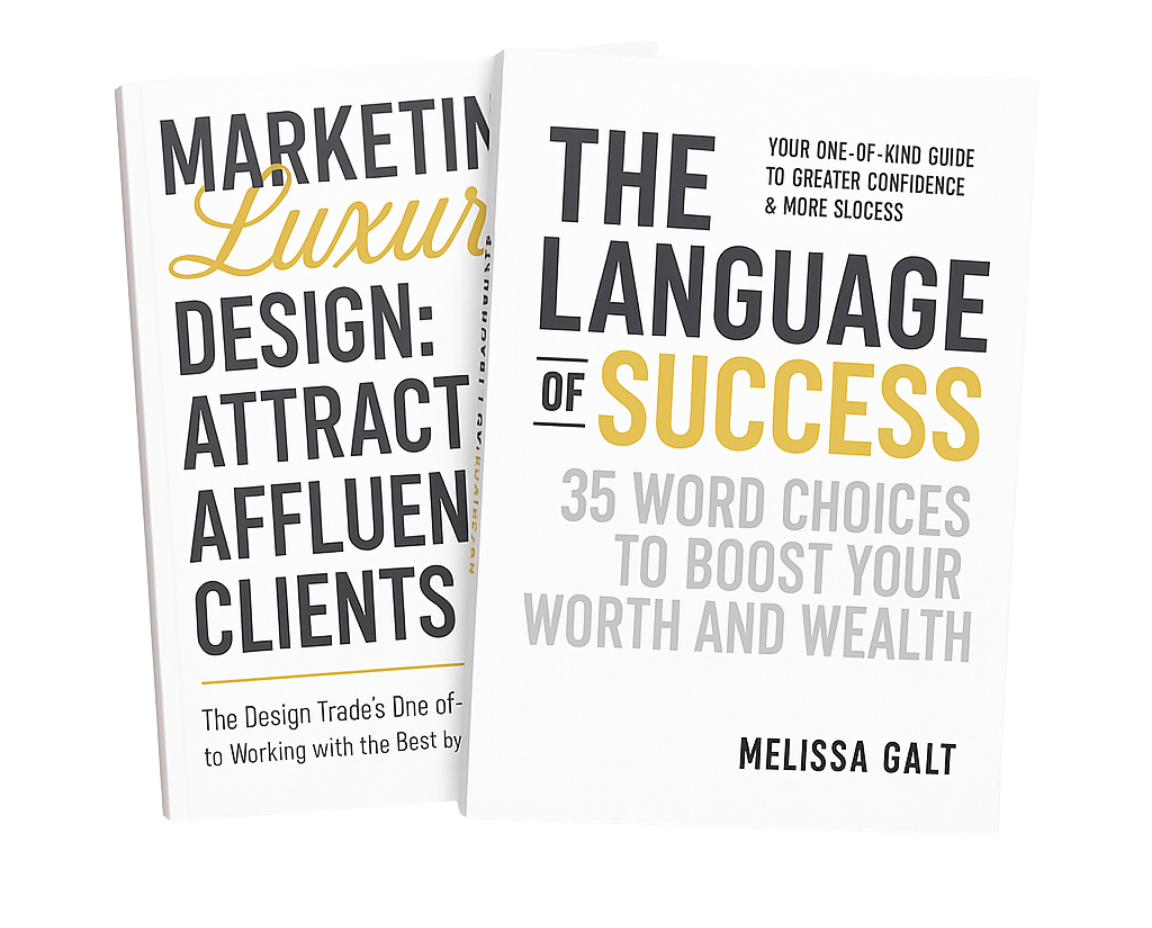
Book Bundle
Marketing Luxury Design:
Attracting Affluent Clients
The Design Trade's One-of-a-Kind
Guide to Working with the Best
The Language of Success:
35 Word to Boost Your Worth & Wealth
Your One-Of-A-Kind Guide To Greater Confidence and More Success

Design Discovery
The Proven Process To Land
Ideal Clients and Grow Profit