
How Interior Designers Win Affluent Clients Without Being Pushy

Affluent clients hire the interior design firm owner who leads with confidence, respects their time, and speaks the language of value. Pushy tactics and generic promises repel the exact people you want. Here is how to market your interior design practice so the right high-caliber clients lean in, without the hard sell.
Key Takeaways
✓Affluent clients rank trust and timing above fee when they choose a designer, so lead with a clear process and calm confidence, never a discount or a countdown timer.
✓Vague language is what makes marketing sound generic. “Italian marble selected for durability and visual impact” outperforms “luxury finishes” because it lets the client picture the result.
✓Retiring one word from your vocabulary (“expensive”) and pricing the transformation instead of the hours changes what clients invest on every project.
✓When Melissa Galt applied these shifts in her own Atlanta firm, she went from 40 clients to 10, from 70-hour weeks to 40, and doubled revenue for the fifth year in a row.
What do affluent clients actually want before they hire an interior design firm?
Affluent clients want to feel safe, understood, and in control before they commit. They care about trust, privacy, and their highly valuable time far more than they care about a lower fee. When designers survey how these buyers decide, the order is consistent: trust first, then timing (how long will this take), then effectiveness, and only then the investment.
That order tells you where to spend your marketing energy. Build trust with a real point of view and a visible process. Answer the timing question early. Prove effectiveness with stories and outcomes. The fee conversation takes care of itself when the first three are solid.
It also tells you who to turn away. Not every prospect with resources is a fit. Melissa’s Design Discovery™ process uses a Five-Factor Fit Filter (investment alignment, timeline realism, decision authority, behavioral signals, and an energy check) with a simple Rule of Three: when three or more of the five feel unstable, it is not a fit, and the elegant no protects your calendar and your team. Marketing that attracts everyone attracts the wrong someone.
How do you market to affluent clients without sounding generic?
You market to affluent clients by being specific, showing expertise, and positioning yourself as a strategist rather than a vendor. Generic language is the fastest way to sound like every other firm. “Luxury materials” says nothing. “Hand-finished walnut cabinetry” or “performance fabrics chosen so the room lives well for 15 to 20 years” gives the reader a picture and a reason.
A few moves that raise your caliber immediately:
- Show your process, not only your portfolio. High-net-worth clients want to know you can handle moving parts, collaborate with builders and trades, and lead without drama. Walk them through how you work. A clear process signals you can be trusted with a project that runs for months.
- Use fewer images, and make each one exceptional. For this audience, imagery should engage the imagination and suggest a sophisticated life, not shout “look at my skills.” Curate hard. One artful photo beats a gallery of good-enough shots.
- Drop urgency tactics. Countdown timers and scarcity deadlines underperform with wealthy buyers. A 2025 analysis from Complete Controller on luxury audience targeting notes that fear-of-missing-out pressure does not create the same spike at the high end. Offer choices and information, and this buyer responds with reciprocity.
Position yourself as the expert partner in the outcome. Melissa’s credibility here is not borrowed. She is the great-granddaughter of Frank Lloyd Wright, spent 30 years as a residential designer, and wrote the book Marketing Luxury Design: Attracting Affluent Clients, described as the industry’s proven pathway to working with the best. Your own authority may look different, and you build it the same way: a clear point of view, stated out loud, backed by results.
What words should interior design firm owners stop using with affluent clients?
Retire the word “expensive.” It is meaningless without context, and it reflects a limiting belief that has no place in a conversation with someone in a higher tax bracket than yours. When you reach for that word, you are selling the way you would buy, and you hand your ceiling to a client who never had one.
Here is what that looks like in real life. Melissa was helping a client frame an extraordinary collection of rock-and-roll posters. Her framer, Scott, had worked with her for years. The client pulled a gorgeous frame and asked about it. Scott said, “Well, that one is going to be expensive.” Melissa reframed it on the spot: “That is going to be absolutely the right and perfect choice for this piece. You are only going to frame this once, and we want the frame to be the stage for this artwork for the rest of its life.” She erased the word before it could take root, and the client chose the finer frame.
Swap spending language for investment language everywhere, in front of clients and behind the scenes, because you cannot split your vocabulary in two. Design is a short-term investment with a long-term return, measured across 15 to 20 years of daily living rather than on invoice day. When you frame it that way, a significant number stops feeling large and starts feeling wise.
One caution: warning a client away from the finer option can feel generous, yet it quietly teaches them the best of your work is out of reach and trains them to negotiate against themselves. Show the value, then trust them to invest.
Where do you actually meet affluent design clients?
You meet affluent clients by being present, in person, where they already gather, not by hiding behind your laptop. Melissa calls this Proximity to Profit™: intentional presence in specific venues where ideal clients, profit partners, and gate openers spend their time. Get out of your office and let people know you as a person, because design is an intimate business and clients want to know your values and interests alongside your expertise.
The practical rhythm is to add three to four of these opportunities to your calendar each month. Choose venues that reflect who you are at the next level, so the conversations feel natural and referrals follow. A short sample from the 30 venue types she maps:
- Wine tastings and dinners, ticketed events that will deliver quality connections
- Social and business clubs including Invited Clubs across the country
- Museum patron circles and art gallery collector receptions
- Wealth advisor, private banker, and family office hosted events
- Upscale yoga and pilates studios, and quality gym memberships
Then build a referral pipeline on purpose. Develop relationships with the other professionals who already serve wealthy homeowners, especially architects, luxury builders, and high-end real estate agents. One good relationship with a luxury residential agent can send you a stream of qualified homeowners for years. A referral tells you someone is interested, though, not that they are qualified, so run every referral through your same discovery process. No shortcuts.
How should you present your fees so affluent clients see value?
Price the transformation, never the hours, and say your number out loud without apologizing for it. Hourly billing caps your revenue at your calendar and trains clients to watch the clock. Flat fees tied to the result protect both your profit and your sanity, and they signal caliber. The relevant math is not your time. It is a home your client will live in every day for 15 to 20 years.
Three practices that make the fee land:
- Set a minimum and mean it. Your design fee minimum is a boundary that protects profit and screens for clients who value what you do. Designers who plateau are usually the ones saying yes to anyone with a pulse and a Pinterest board.
- Walk the Letter of Agreement live. Present it on Zoom or in person, connect every line to a benefit, then share the design investment and stop talking. The pause after a confident fee is where the yes lives. Over-explaining and the nervous discount create the hesitation you fear.
- Raise on the next project, not the last one. Honor current commitments, then set the new fee on your very next proposal. No announcement, no permission slip. The only person who needs to believe it is you.
A slow or cautious market is the worst possible moment to discount and the best possible moment to stand in your value. The money at the top has not disappeared. It is choosing the designers who lead with confidence instead of flinching toward a lower number. Discounting does not attract grateful clients; it attracts the ones who question every invoice and drain your team. Your fee is a filter, and you are not expensive. You and your design are an investment with a long-term return that exceeds nearly every other investment a client will make.
FAQ’S
How do interior design firm owners attract affluent clients without being pushy?
Lead with trust and a clear process instead of pressure. Affluent clients respond to choices and information, not urgency tactics or discounts. Show your expertise through your process, your point of view, and real client outcomes, then let them decide. When you respect their control and their time, they reciprocate with commitment.
What should interior design firm owners charge affluent clients?
Charge a flat fee tied to the transformation, with a firm project minimum that reflects the caliber of client you want. Melissa Galt teaches six flat-fee formulas that price any project with confidence and treat hourly billing as a trap that caps your revenue. Set the smallest project worth your time, talent, and team, and hold it.
Where do interior designers find high-net-worth clients?
Interior designers find high-net-worth clients by showing up in person where those clients already gather and by building referral relationships with architects, luxury builders, and high-end real estate agents. Add three to four aligned venues each month, from designer show houses to private club events. Presence and relationships beat any laptop-based marketing campaign.
How do I stop sounding generic in my interior design marketing?
Replace vague claims with specific detail and a genuine point of view. Swap “luxury finishes” for the exact material and the reason you selected it, use fewer and finer images, and retire spending words like “expensive” in favor of investment language. Specificity signals expertise, and expertise is what affluent clients pay for.
To find where your own marketing leaks these clients and build the plan to fix it, Melissa offers a complimentary, confidential Design Business Assessment™ by Zoom. You leave with a clear path forward, whether or not you ever work together.

GET MORE OF MELISSA, ON THE PODCAST!
Subscribe to the podcast, Design Business Freedom™, and get the best in smart systems, proven processes, and the right strategies and resources to take your design practice to the next level.
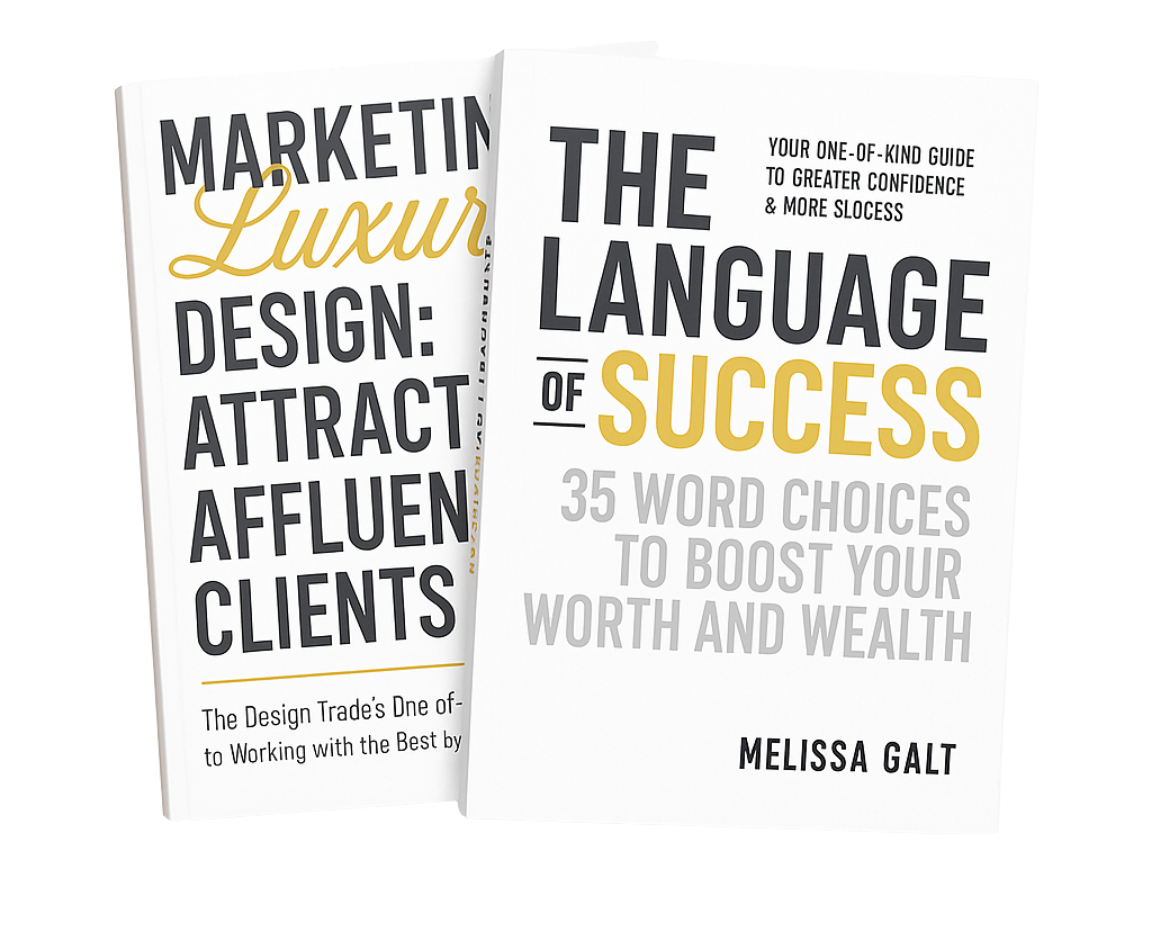
Book Bundle
Marketing Luxury Design:
Attracting Affluent Clients
The Design Trade's One-of-a-Kind
Guide to Working with the Best
The Language of Success:
35 Word to Boost Your Worth & Wealth
Your One-Of-A-Kind Guide To Greater Confidence and More Success

Design Discovery
The Proven Process To Land
Ideal Clients and Grow Profit